Engineering Robust Multi-Source Retrieval Systems
Connecting Isolated Document Knowledge with Structured Entity Relationships
1. Architecture and Data Modeling for Retrieval
Generative language models are fundamentally synthesis and presentation interfaces; their operational reliability is bound directly to two pillars: the Information Retrieval (IR) system feeding them context, and the downstream guardrails and policy constraints governing their output.
Every storage paradigm possesses distinct structural properties and retrieval advantages. Consequently, committing to a single retrieval modality limits the scope of information a system can access:
- Vector indices provide fuzzy semantic search across text but cannot execute deterministic aggregations or traverse multi-hop relationships.
- Relational databases (SQL) guarantee exact filtering and transactional metrics but cannot resolve conceptual nuance in unstructured narratives.
- Knowledge graphs map explicit ontological hierarchies and dependencies, but lack continuous representations for open-ended semantic discovery.
When a query demands narrative context, exact counts, and entity relationships, relying on any single engine guarantees incomplete context assembly. In database engineering, storage systems are modeled around predictable read and write patterns; retrieval-augmented architectures require the identical discipline. Rather than forcing all enterprise knowledge into a uniform embedding space, robust architectures practice intentional partitioning—co-designing the entire data stack around specialized engines.
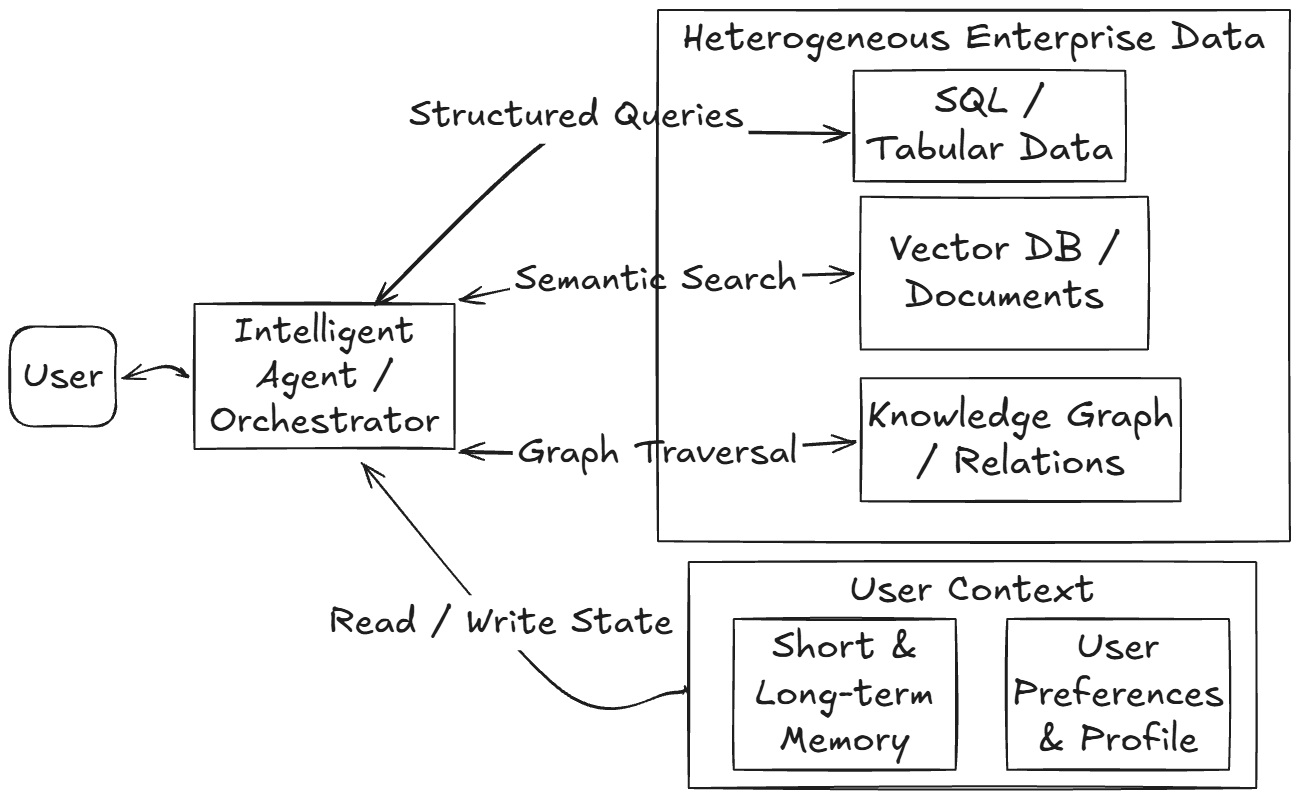 (Figure 1: High-Level Architecture — Agent Orchestrator Bridging User Context and Heterogeneous Enterprise Data)
As shown in Figure 1, the agent acts as an orchestrator bridging persistent user context (session memory and domain preferences) with specialized backends. Rather than issuing indiscriminate searches, the orchestrator analyzes incoming queries to execute deliberate tool paths: dispatching parameterized SQL for analytical operations, traversing knowledge graphs for multi-hop entity relationships, or querying hybrid vector indices for narrative text. The retrieved records are then deduplicated and normalized into a token-budgeted payload, giving the model clear, grounded context without cognitive bloat or excessive latency.
However, querying multiple backends introduces its own challenges, from wrong routing decisions to mismatched entities. Because all retrieved information is ultimately passed to the model as text, effective context engineering is critical. Tables, graph relationships, and document excerpts must be clearly structured and labeled so the model understands where each fact comes from and knows when data is simply missing.
2. Case Study: Clinical Intelligence via Multi-Path Retrieval
To evaluate this architectural model under real constraints, we built an internal proof-of-concept (PoC) using public ClinicalTrials.gov protocols and structured adverse-event reporting datasets (such as FDA FAERS). This domain exemplifies the failure modes of single-paradigm retrieval: trial protocols are dense, unstructured narratives, while safety registries are strictly structured, numerical datasets.
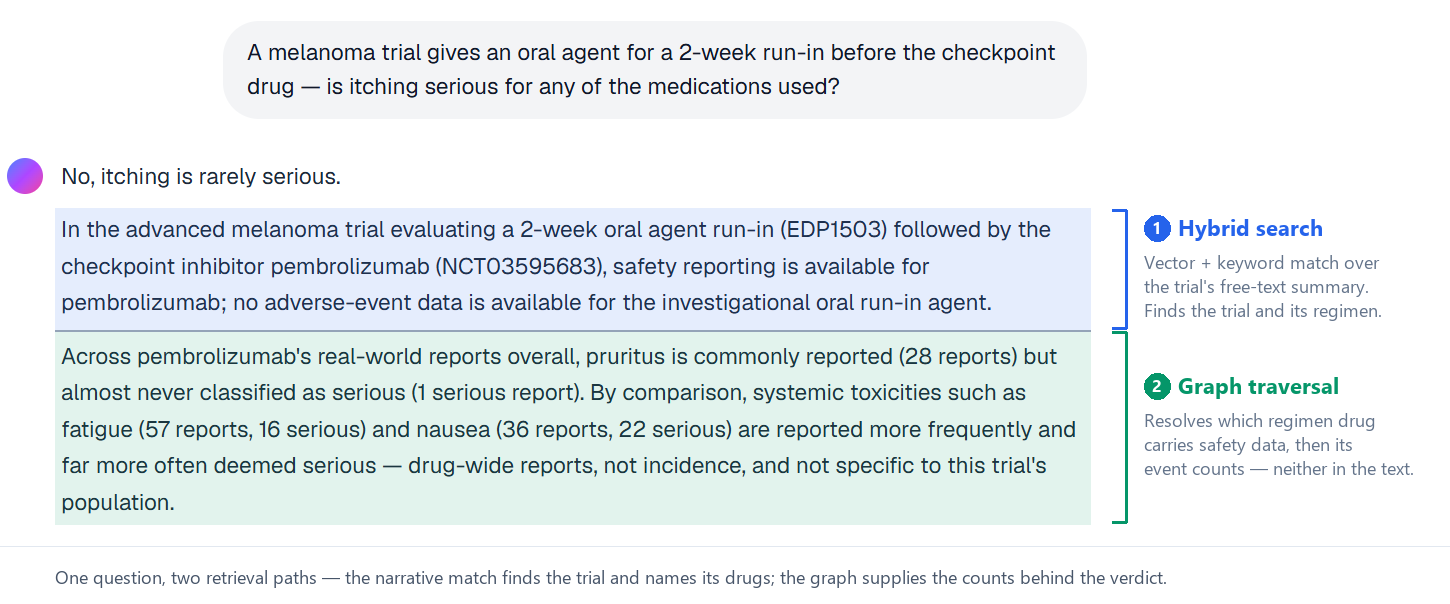 (Figure 2: Output from our internal PoC interface demonstrating multi-path retrieval — "One question, two retrieval paths: the narrative match picks the trial; the graph supplies the numbers.")
The Problem Query
"A melanoma trial gives an oral agent for a 2-week run-in before the checkpoint drug — is itching serious when this medication is used?"
Why Single-Paradigm Retrieval Fails
- Vector Search Alone: A vector index matches the semantic description of the trial design ("melanoma trial", "2-week oral run-in before the checkpoint drug"), pinpointing clinical trial
NCT03595683. However, the quantitative safety profile and drug-wide adverse event registries live outside the trial summary document. Pure vector retrieval cannot surface figures that simply do not exist in the source narrative. - Structured Search (SQL/Graph) Alone: A database cannot interpret descriptive, informal clinical language ("oral agent for a 2-week run-in") to resolve the relevant trial or compound without prior entity extraction.
The Compositional Pipeline in Action
As captured in Figure 2, the PoC resolves this through two coordinated retrieval stages:
- Path 1 (Hybrid Free-Text Search — Vector + BM25): Evaluates the clinical description against unstructured protocol summaries, successfully identifying the matching trial (
NCT03595683) and extracting the tracked compound (pembrolizumab). - Path 2 (Ontological Graph Traversal): Uses the extracted entity to traverse the knowledge graph into adverse event registries. It extracts verified reporting statistics: pruritus (itching) is frequent but rarely serious (1 serious report out of 28 total), contextualized against other common events such as fatigue (57 reports, 16 serious) and nausea (36 reports, 22 serious).
- Synthesis: The model receives verified entity links and deterministic counts, producing a coherent, evidence-backed assessment that directly answers the user's inquiry.
Critically, achieving this outcome is not merely the result of connecting a vector index to a database. It is the product of deliberate agent and graph engineering: modeling an ontology that maps disparate trial entities to standardized compound registries, and designing the agent's orchestration logic to reliably resolve ambiguous entities before executing multi-hop traversals.
3. Observability and Systematic Evaluation
Multi-stage retrieval architectures inevitably introduce coupled failure modes: an initial hybrid search miss can parameterize downstream graph traversals with the wrong entity, while gaps in graph coverage can trigger subtle hallucinations if the model attempts to interpolate missing statistics. Managing these risks requires end-to-end telemetry that instruments each boundary independently—tracking query classification, hybrid recall, entity resolution confidence, and context assembly budgets. With granular, per-branch tracing, engineering teams can instantly diagnose whether an off-target answer stems from a retrieval gap, an entity mismatch, or a generation error, supported by continuous live monitoring and periodic human-in-the-loop reviews to audit edge cases.
Ensuring system stability over time also demands continuous, systematic evaluation rather than subjective spot-checking. Automated benchmark harnesses should evaluate retrieval fidelity, verify that generated answers remain strictly grounded in returned evidence, and confirm deterministic refusal behaviors when data is absent. Running curated, domain-specific regression suites against every pipeline update guarantees that tuning an index, altering chunk boundaries, or updating an ontology in one component does not silently degrade downstream decision support. Building dependable enterprise AI is fundamentally an applied software and data engineering discipline, where predictable outcomes are the direct result of deliberate system architecture.
Conclusion
Building dependable AI-assisted decision-support systems is not about wrapping APIs around commercial models. It is an applied systems engineering discipline that requires deliberate data modeling, multi-source retrieval architectures, and systemic validation. Reliable responses are the product of sound architecture, not black-box tuning.

Kostas Tsolis
Director - Founder
ML engineer and founder of Dialectos.AI. Specializes in turning complex data signals into actionable business intelligence.