Fine-Tuning vs. Frontier Models: Navigating the Operational Trade-Offs
When does it make sense to self-host a fine-tuned model instead of calling an API? A look at model capacity, data distribution shifts, and why hybrid routing might be your best bet.
What Fine-Tuning Actually Buys You (and What It Costs)
Fine-tuning smaller, open-weights language models has become remarkably accessible. With techniques like QLoRA, a compact model can be adapted on a consumer GPU in minutes to a couple of hours.
At first glance, initial benchmark results can make fine-tuning look like an easy conclusion: a sub-3B local model matching a massive frontier model on a complex business task. Yet choosing a smaller architecture is rarely just about chasing headline accuracy; it is usually driven by hard operational constraints like air-gapped data boundaries, strict latency limits, or running on constrained edge compute. The real trade-off isn't whether fine-tuning works—it does. The question is how that compact model holds up once production inputs shift away from the training distribution, and whether your team is prepared to own the operational lifecycle that comes with a frozen asset.
Part 1: Baseline Task & In-Distribution Performance
To look at concrete numbers, we evaluated a common enterprise workflow: mapping raw customer support tickets to a strict JSON structure containing intent, category, extracted entities, and an escalation flag.
We ran three compact open-weights models through a single ~1-hour QLoRA pass on a consumer GPU—Gemma 3 270M, Gemma 3 1B, and Llama 3.2 3B—and compared them against Claude Opus 5 as a hosted frontier baseline.
When evaluated against a held-out in-distribution test set (757 tickets) matching the training data's phrasing and structure, fine-tuning delivers an immediate leap:
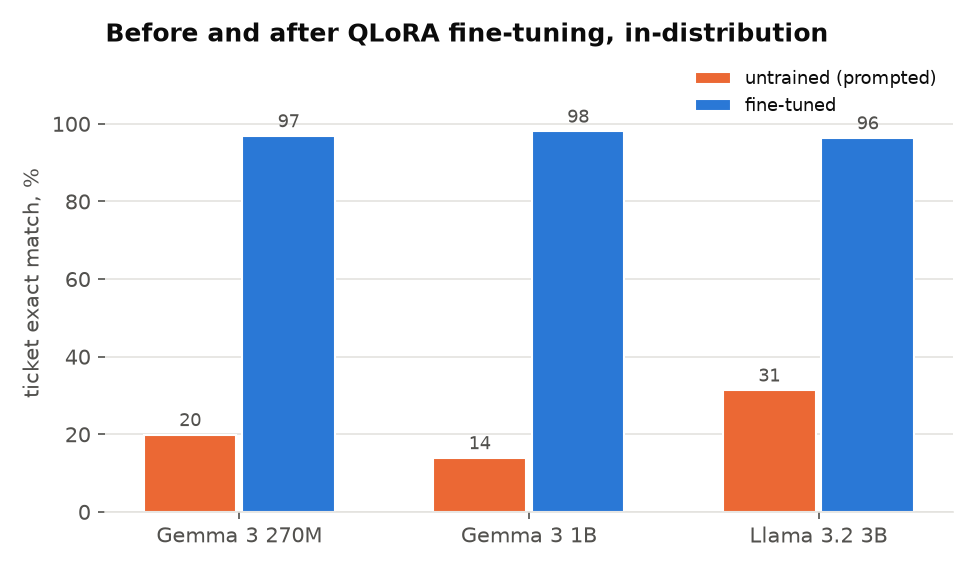
- Gemma 3 270M: 20% prompted → 97% fine-tuned
- Gemma 3 1B: 14% prompted → 98% fine-tuned
- Llama 3.2 3B: 31% prompted → 96% fine-tuned
On familiar territory, all three models cluster within two percentage points of Claude Opus 5 (98.5%). If the evaluation stopped here, relying on a hosted frontier model would seem unnecessary.
Part 2: What Happens When Data Shifts
In production, customer inputs do not stay perfectly aligned with a static training set. Product lines update, terminology evolves, and customer phrasing drifts.
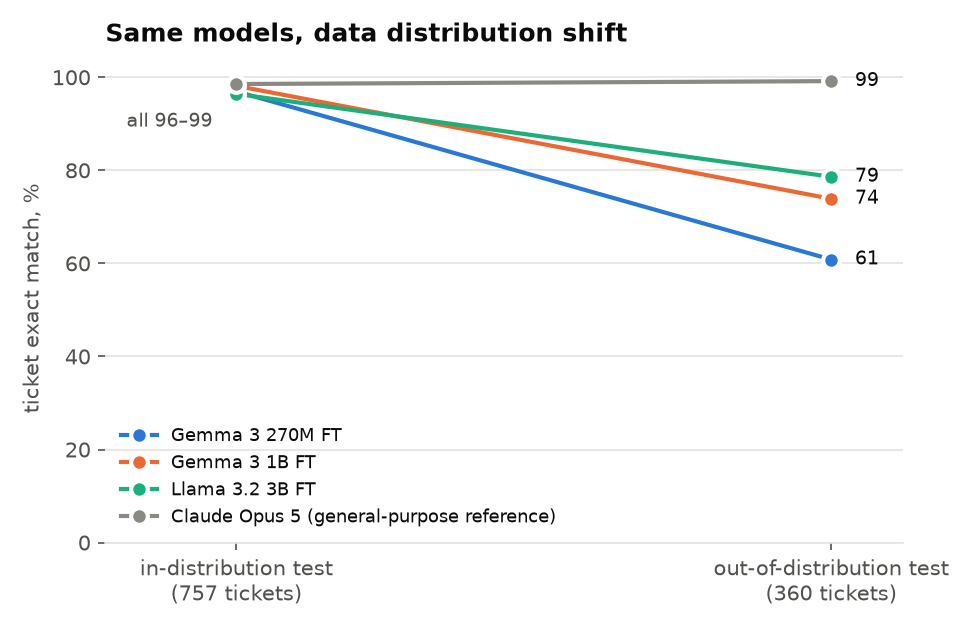
When we evaluate the exact same fine-tuned models against the 360 out-of-distribution tickets, the picture changes significantly.
The Capacity Gap
While Claude Opus 5 holds steady at 99% exact match across both sets, the fine-tuned models experience sharp declines:
- Llama 3.2 3B: Drops from 96% → 79% (−17 percentage points)
- Gemma 3 1B: Drops from 98% → 74% (−24 percentage points)
- Gemma 3 270M: Drops from 97% → 61% (−36 percentage points)
A few key dynamics stand out in the data:
- In-distribution tests hide underlying model capacity. On familiar data, the 270M, 1B, and 3B models were separated by barely 2 percentage points. Once off-distribution, an 18-point gap opens between the 270M and 3B models. While all three models successfully learn the task within the training distribution, larger base models have more underlying representational capacity to fall back on when novel phrasing or edge cases appear.
- The drop is uneven across fields. The degradation is not uniform across the entire JSON object. Routine structural work like entity extraction holds up relatively well (dropping from 98.9% to 92.5%). However, nuanced judgment calls like policy escalation drop steeply (from 97.1% to 56.2%). The models master the specific task format, but cannot compensate for missing general reasoning when unfamiliar inputs arrive.
Part 3: Operational Trade-offs (Ownership vs. Upkeep)
Given the performance drop outside the training distribution, choosing between a fine-tuned self-hosted model and a managed API is not just a question of benchmark accuracy. It is a fundamental engineering architecture decision.
1. On-Device Execution and Open Weights
Often, the actual deciding factor for fine-tuning is the physical deployment footprint. A sub-3B model compiles down to a file of just a few gigabytes that can run on basic consumer GPUs or edge processors. Under open-weights licensing, you can deploy this artifact entirely on-device or within an air-gapped on-premise server. This fulfills strict data privacy requirements (zero data exfiltration), eliminates network latency, and completely removes per-call API inference costs.
2. Stability vs. Upstream Progress
- The Frozen Dependency Advantage: When you host fine-tuned weights, the component becomes completely deterministic. It will produce the exact same outputs next year. By bringing the weights in-house, you insulate your application from vendor infrastructure failures and API outages. Even more critically, you become immune to forced deprecation schedules and prompt breakage caused by silent upstream model updates.
- The Frozen Dependency Penalty: The trade-off for this stability is detaching from the broader AI improvement curve. Hosted models continuously get cheaper, faster, and smarter without any effort on your end. Your fine-tuned artifact remains static until your team explicitly re-trains, re-validates, and redeploys it.
3. The Real Durable Asset: The Eval Suite
Because fine-tuning is cheap—taking just an hour on a commodity GPU—the model weights themselves are essentially disposable artifacts. Writing, curating, and human-verifying the 360 out-of-distribution test cases took significantly longer.
In enterprise deployments, your evaluation suite is the real proprietary asset. Without a rigorous, held-out dataset, you cannot detect when real-world production inputs have drifted past your model's reliability envelope.
Part 4: The Decision Framework
Fine-tuning is neither a silver bullet nor an outdated practice—it is an architectural choice with clear trade-offs.
| Factor | Favor Fine-Tuned Local Models | Favor Hosted Frontier APIs |
|---|---|---|
| Data Privacy / Governance | Strict on-prem or zero-data-exfiltration requirements. | Data processing agreements with third-party vendors are acceptable. |
| Task Stability | Well-defined, static business rules and taxonomies. | Rapidly changing policies, frequent prompt iterations, or novel product categories. |
| Traffic Volume | High, steady query volume where token-based billing becomes expensive. | Low-to-moderate volume, variable traffic, or experimental features. |
| Latency & Payload | Compact prompts (70–95 tokens) with low latency requirements. | Long, context-heavy system prompts (1,000+ tokens) acceptable per request. |
| Team Bandwidth | Team is willing to own deployment, monitoring, and periodic retraining. | Team prefers offloading infrastructure and maintenance overhead. |
The Hybrid Alternative
In practice, seeing the big picture often means avoiding a strict binary choice altogether. Because fine-tuned models are highly effective on familiar data and inexpensive to run, teams can—assuming data privacy and deployment constraints permit it—adopt a hybrid routing architecture.
The compact model acts as the frontline worker, processing the bulk of high-volume, predictable traffic at near-zero marginal cost. Meanwhile, the hosted API serves as an escalation path. When input monitoring detects a novel or out-of-distribution request, the system routes that specific ticket to the larger model to leverage its superior reasoning capacity.
The Bottom Line
Evaluating AI solutions requires stepping back from headline accuracy and looking at the complete operational picture.
Fine-tuning allows small models to punch far above their weight on specific tasks, offering unmatched privacy, speed, and cost control. But they are specialized components, not general-purpose thinkers. Managed APIs provide broad reasoning and resilience out of the box, but tie you to recurring costs and external vendor lifecycles.
Both paths—or a hybrid of the two—are entirely defensible. The real failure mode is making a long-term architectural commitment based solely on a single benchmark score, without understanding your real-world constraints, your appetite for maintenance, and how your system will react when the data inevitably shifts.

Kostas Tsolis
Director - Founder
ML engineer and founder of Dialectos.AI. Specializes in turning complex data signals into actionable business intelligence.